
Wieliczka Salt Mine Facts
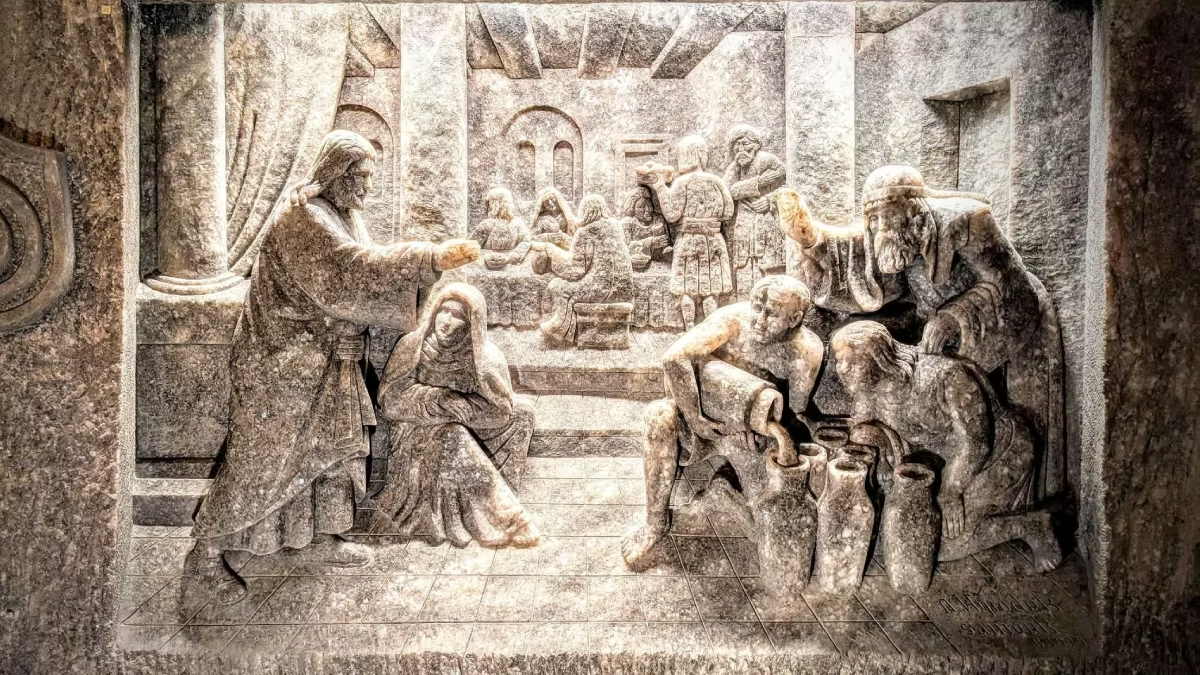
Some places are better understood through numbers than through photographs. Wieliczka Salt Mine is one of them. The scale of the place only registers when you start doing the arithmetic — and the arithmetic is startling.
The Mine by Numbers
Wieliczka Salt Mine has 9 levels reaching 327 metres deep, over 287 km of tunnels, and more than 2,350 chambers. The Tourist Route covers less than 2% of the total. It was one of the first 12 UNESCO World Heritage Sites in 1978. Commercial mining ceased in 1996 after 700+ years of continuous operation. Over 23 million tonnes of rock salt were extracted during its working life. Up to 9,000 visitors descend underground every day.
| Fact | Figure |
|---|---|
| Number of underground levels | 9 |
| Maximum depth | 327 metres |
| Total tunnel length | Over 287 km |
| Number of chambers | Over 2,350 |
| Tourist Route length | 3.5 km |
| Tourist Route as % of total | Less than 2% |
| Tourist Route stairs | ~800 (380 at the start) |
| Tourist Route depth | 64–135 metres |
| Exit elevator speed | ~30 seconds to surface |
| Elevator capacity | 36 people (4 cars × 9) |
| Underground temperature | 17–18°C year-round |
| Miners on site today | Several hundred |
| Annual visitors (approx.) | 1.5 million |
| Rock salt extracted (total) | ~23 million tonnes |
| Geological age of salt deposits | ~13.6 million years |
| Years of continuous operation | 700+ (13th century–1996) |
| UNESCO inscription | 1978 — original list |
25 Things Most Visitors Don’t Know
1. It was one of the first 12 UNESCO World Heritage Sites ever. In 1978, when the UNESCO World Heritage List was established, Wieliczka was among the inaugural 12 inscriptions. The other 11 included the Galápagos Islands and the Kraków Historic Centre.
2. The rock salt is grey, not white. The salt deposits at Wieliczka are naturally grey — varying shades of grey-green, grey-brown, and silver — due to mineral impurities. Most visitors expect white crystalline salt and are surprised.
3. Copernicus was one of the first tourists. Nicolaus Copernicus is believed to have visited the mine around 1493 — before he revolutionised astronomy. He is considered one of the earliest named non-working visitors. A salt statue of him marks the chamber that bears his name.
4. Salt funded Poland’s first university. During the reign of Casimir the Great (14th century), revenue from Wieliczka salt accounted for up to a third of the royal treasury. That wealth helped fund the founding of the Jagiellonian University in Kraków in 1364.
5. The chandeliers are not carved — they’re grown. The crystal chandeliers in St. Kinga’s Chapel are made from salt crystals that have been dissolved in water and reconstituted through controlled crystallisation, allowing them to achieve transparency. Direct-carved salt would be grey.
6. St. Kinga’s Chapel took 67 years to complete. Work began in 1896. Three primary miner-artists — brothers Józef and Tomasz Markowski and Antoni Wyrodek — led the creation. The final sculptures were added in the late 20th century.
7. The underground lake water is denser than the Dead Sea. The saline lake in the Weimar Chamber has an extremely high salt concentration — denser than the famously saline Dead Sea.
8. The mine was on the UNESCO Danger List. From 1989 to 1998, Wieliczka was on the UNESCO List of World Heritage in Danger due to humidity damage to the sculptures from artificial ventilation. A conservation programme resolved the issue.
9. Horses lived underground for years. Working horses were kept underground for extended periods — sometimes for their entire working lives — to haul salt. The last horse, Baśka, returned to the surface well into the 20th century.
10. The Staszic Chamber is 36 metres high. The largest accessible chamber on the Tourist Route is tall enough to fit Poland’s tallest native tree inside it. The Germans attempted to use it as an underground aircraft factory during WWII.
11. An underground balloon flight made the Guinness Book of Records. In 2014, the first underground hot-air balloon flight took place in the Staszic Chamber and lasted 4 minutes — a sufficient feat of engineering and audacity to earn a Guinness world record.
12. The mine has an underground post office. Visitors can send a postcard from 135 metres underground — perhaps the most unusual postal address in Europe.
13. The Penitents were mine safety officers. These miners crawled through the underground passages with torches on long poles, burning off methane concentrations at ceiling level before they could cause explosions. They wore damp clothing as protection against flash fires.
14. Mass is still held every Sunday. St. Kinga’s Chapel is an active consecrated church. Mass is celebrated every Sunday and on Christmas Eve at midnight. Weddings and concerts also take place in the chapel.
15. Goethe visited in 1790. Johann Wolfgang von Goethe descended into the mine during his travels through Poland and was reportedly deeply moved by the underground world. His visit is one of the best-documented early tourist accounts of the mine.
16. The mine extends further than the distance to Kraków’s airport. The 287 km of tunnels is approximately 20 times the distance from the mine to Kraków’s Balice Airport.
17. The mine has a working health resort. The Salt Mine Health Resort at 135 metres depth is an officially certified underground medical facility offering speleotherapy for respiratory conditions including asthma and allergies. Overnight stays are possible.
18. The first underground railway in Poland was here. Starting in the 19th century, an underground railway transported salt ore (and later tourists) through the mine. The first tracks were made of wood because it was feared salt would destroy iron rails.
19. Rock salt mining ended in 1996 but salt production didn’t. After commercial rock salt extraction ceased, the mine began collecting underground brine and evaporating it to produce a premium table salt product. You can buy it in the mine’s gift shop.
20. The mine sits on a salt deposit 13.6 million years old. The Wieliczka salt deposit formed during the Miocene period when a shallow sea covered the region. As the Carpathian Mountains rose, seawater was trapped and evaporated, leaving thick layers of rock salt underground.
21. Less than 2% of the mine is accessible to visitors. The 3.5 km Tourist Route feels substantial — but it represents less than 2% of the 287 km total tunnel network. The mine’s full extent is staggering by any measure.
22. The mine was briefly used as a Nazi armaments factory. In 1944, the Germans established an underground aircraft assembly plant in the Staszic Chamber. Jewish concentration camp prisoners were brought as forced labour. The Soviet advance caused the project to be abandoned before production began.
23. The mine has its own folklore figure — the Skarbnik. The Treasurer Spirit is a mythological guardian of the mine who warns miners of danger. Salt statues of the Treasurer appear on the Tourist Route.
24. Wieliczka is a UNESCO serial property. The full UNESCO inscription now covers Wieliczka Salt Mine, Bochnia Salt Mine (added 2010), and Wieliczka Saltworks Castle (added 2013) as a single serial property — the “Wieliczka and Bochnia Royal Salt Mines.”
25. Up to 9,000 visitors per day descend into the mine. On peak summer days, Wieliczka receives extraordinary visitor numbers — up to 9,000 people underground. This scale of visitation management in a heritage site is itself remarkable.
Book This TourFrequently Asked Questions
How deep is Wieliczka Salt Mine?
The mine reaches a maximum depth of 327 metres across 9 levels. The Tourist Route descends to a maximum of 135 metres at level 3. Visitors begin the descent at the surface and start at level 1, approximately 64 metres underground.
How long has Wieliczka Salt Mine been operating?
Rock salt mining began in the 13th century and operated continuously until 1996 — over 700 years. Salt extraction from brine springs at the same location dates to Neolithic times.
How many people visit Wieliczka Salt Mine each year?
Approximately 1.5 million visitors per year, with up to 9,000 on peak summer days. It is consistently ranked among Poland’s five most visited tourist attractions.
Is Wieliczka Salt Mine still active?
Commercial rock salt mining ceased in 1996. Several hundred miners still work underground daily — maintaining galleries, managing water ingress, and restoring historic chambers. The mine also collects underground brine and produces a small quantity of premium table salt.
How many UNESCO World Heritage Sites are in Poland?
Poland has 17 UNESCO World Heritage Sites as of the latest listing. Wieliczka Salt Mine was one of the first, inscribed in 1978 on the inaugural list.
