
Wieliczka Salt Mine Underground
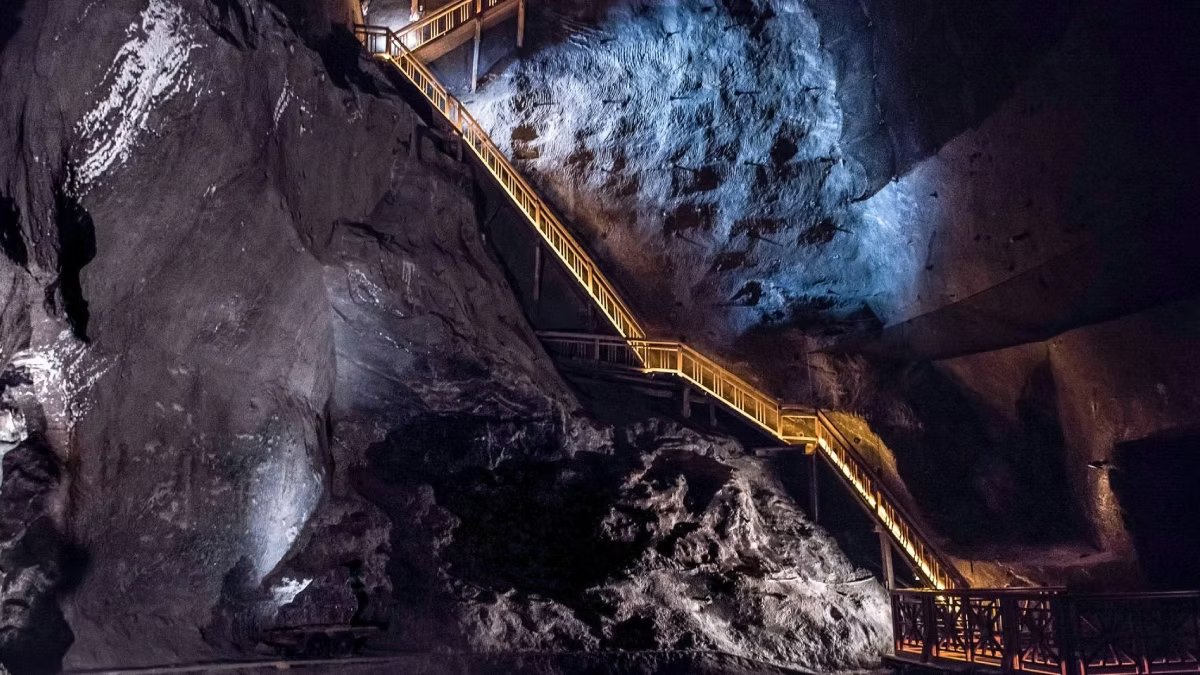
Photographs don’t prepare you for Wieliczka. The scale is one thing — the first chamber is already large enough to disorient — but the more persistent surprise is the atmosphere. The air is different underground here. It’s cool and still and carries a faint mineral quality. The salt walls hold their own silence. Your footsteps sound different depending on the chamber. And then, approximately an hour into the tour, you round a corner and St. Kinga’s Chapel opens in front of you. Every description of the underground experience converges on that moment. Here’s what the full journey actually involves.
The Descent
Underground at Wieliczka Salt Mine you’ll find 22 chambers carved from grey rock salt across three levels reaching 135 metres deep. The temperature is a constant 17–18°C. The air is extraordinarily clean — bacteriologically pure and rich in sodium chloride microelements. The route is 3.5 km long, well-lit, and takes 2–3 hours. The scale, artistry, and atmosphere are consistently described by visitors as exceeding expectations.
The underground experience begins before you reach the first chamber. The Daniłowicz Shaft was sunk in the 17th century and was originally used to transport salt to the surface. Today it carries tourists downward via 380 wooden stairs that spiral into the earth. The stairs are divided into manageable sections of 7–8 steps each, with handrails and resting points. The air cools noticeably as you descend. By the time you reach the first level at 64 metres, the temperature has settled to 17–18°C and the world above has become irrelevant.
The descent takes approximately 10–15 minutes and is the most physically demanding part of the Tourist Route. Fit visitors find it easy; older visitors and those with knee concerns are sometimes surprised by the length of it. Descending 380 steps feels longer than it sounds — though never difficult enough to deter anyone with average mobility.
The Air Underground
One of the least-expected aspects of the underground experience is the quality of the air. The mine’s rock salt environment is bacteriologically near-pure — the saline microclimate inhibits microbial growth in a way that has been studied and exploited medicinally since the 19th century, when physicians first began sending patients underground for respiratory treatment. The Wieliczka Salt Mine Health Resort, at a depth of 135 metres, has been providing speleotherapy (salt cave therapy) for respiratory conditions including asthma, allergies, and bronchitis for over a century.
You don’t need to visit the health resort to notice the air quality. Most visitors describe the underground air as somehow cleaner, crisper, and more restful than surface air. It’s not a placebo — the bacteriological analysis of the mine’s atmosphere consistently shows extremely low microbial counts. People with respiratory sensitivities sometimes find the two to three hours underground genuinely beneficial.
What the Rock Salt Actually Looks Like
Rock salt at Wieliczka is naturally grey — varying shades of grey-green, grey-brown, and silver-grey, depending on mineral composition. It resembles unpolished granite. Visitors expecting white crystalline salt are often surprised. The carved sculptures can appear almost stone-like in photographs. The chandeliers in St. Kinga’s Chapel are made from reconstituted salt crystals specifically chosen and processed to achieve transparency.
This surprises almost everyone on their first visit. The salt is not white. It is grey — granitic, heavy-looking, muted. Individual veins and bands of different mineral composition create variation in the walls: streaks of brown, patches of green, areas of deeper grey. The sculptures carved from this material look almost like stone — until your guide tells you to lick the wall. Many visitors do.
The Lighting
The chambers are well-lit with electric lighting specifically designed to highlight the sculptural and architectural features of each space. The quality varies by chamber — some are warmly lit to create a cathedral-like atmosphere; others are cooler and more clinical, allowing the geological structure of the salt to read clearly. St. Kinga’s Chapel uses the most sophisticated lighting, including colour-temperature variation to enhance the chandeliers and bas-relief carvings. The Weimar Chamber’s underground lake benefits from lighting angled to create reflection effects.
There are no areas of darkness on the Tourist Route. The galleries between chambers are lit throughout. Photography without flash produces good results in all major chambers due to the quality of the installed lighting.
The Tunnels Between Chambers
Not everything underground is cathedral-scale. Between the major chambers, the Tourist Route passes through narrower galleries — some wide enough for two people to pass comfortably, others that require single-file movement. Ceiling heights vary from comfortable standing height to sections where taller visitors need to watch their heads. The floors are largely level and paved with salt-composite material, though there are staircases between levels. None of this is difficult — but it contributes to the sense of genuine exploration rather than simply walking through a museum.
The wooden support structures visible in many of the older galleries are original — some dating back several centuries. They were built using the “room and pillar” method to prevent collapses, and the quality of their preservation is one of the things that makes Wieliczka genuinely different from reconstructed heritage sites.
The Underground Lake
At the Weimar Chamber, the route passes the mine’s most atmospheric water feature: a still, green-tinted saline lake whose surface reflects the illuminated salt ceiling. The water is denser than the Dead Sea due to its extreme salinity. The chamber is completely quiet. Many visitors describe this as the most unexpectedly moving moment of the tour. For more detail, see our dedicated Underground Lake guide.
The Underground Restaurant
At 125 metres — the deepest point of the Tourist Route — visitors reach Karczma Górnicza, an underground restaurant in the Witold Budryk Chamber. Traditional Polish food is served buffet-style at the wooden communal tables. Eating 125 metres underground with salt walls on all sides, lit by underground electric light, is an experience that requires no additional enhancement. See our Restaurant guide for full details.
The Exit
After the restaurant and gift shops, visitors gather at the lift station for the return to the surface. The exit elevator is a compact industrial cage holding nine people per car, four cars per trip, 36 people total. The ride to the surface takes approximately 30 seconds. It is fast. For some visitors, the sudden small-enclosed-space moment is the most intense of the entire tour — more so than the underground chambers themselves, which are generally spacious. See our Elevator guide for more on what to expect.
Frequently Asked Questions
What is it like underground at Wieliczka Salt Mine?
The underground experience is consistently described as exceeding expectations. The combination of scale, artistry, atmosphere, and the quality of the air creates something genuinely unlike any other tourist attraction. The major chambers are spacious and well-lit. The temperature is a comfortable 17–18°C. The salt walls are grey — not white — and the sculptures carved from them look almost like stone. St. Kinga’s Chapel is the moment most visitors remember for longest.
Is it dark underground at Wieliczka Salt Mine?
No — the Tourist Route is fully illuminated throughout, with designed lighting in all major chambers and galleries. There are no areas of darkness. The Miners’ Route operates with only personal headlamps in some sections, which is part of its different character.
Is Wieliczka Salt Mine claustrophobic?
The Tourist Route’s main chambers are remarkably spacious and most visitors with mild claustrophobia manage without difficulty. The exit elevator is the single most enclosed moment of the tour — 30 seconds in a compact industrial cage. The narrow galleries between chambers are the second most enclosed. If you have significant claustrophobia, researching the elevator experience in advance is advisable.
How deep underground does the Wieliczka tour go?
The Tourist Route descends to a maximum of 135 metres underground at level 3. The descent begins from the surface and reaches 64 metres at level 1. Visitors exit by lift from level 3.
Is the underground air good for your health?
The mine’s air is bacteriologically near-pure and rich in sodium chloride microelements. Speleotherapy at Wieliczka has a long medical history, particularly for respiratory conditions. The mine houses an official health resort at 135 metres depth. Most visitors simply notice that the air feels particularly clean and restful.
