
St. Kinga's Chapel
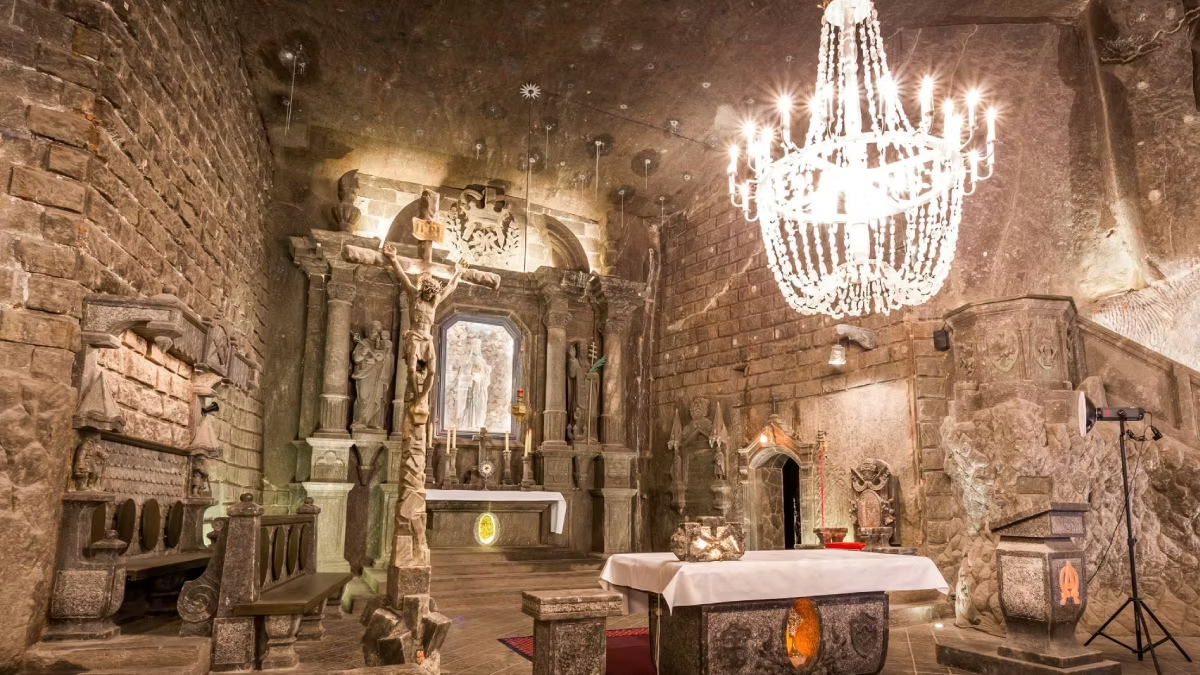
There is a moment on the Tourist Route, somewhere around the final descent into level 3, when visitors round a corner and the chapel opens up in front of them. The scale of it — the height of the ceiling, the warmth of the chandelier light, the silence that comes from somewhere deep in the salt itself — stops people mid-step. This happens every tour, every day, to visitors who have seen photographs and still weren’t prepared for the real thing. St. Kinga’s Chapel is, by any honest measure, one of the most extraordinary spaces in the world. Here’s everything you need to know before you see it.
The Dimensions
St. Kinga’s Chapel is the centrepiece of Wieliczka Salt Mine, located 101 metres underground on level 3. It measures 54 metres long, 18 metres wide, and 12 metres high, with a floor area of 465 square metres. Every element — the floor, walls, altar, bas-relief carvings, and chandeliers — is made entirely from rock salt. Construction began in 1896 and took approximately 67 years. The chapel is included in all standard Tourist Route tickets and cannot be visited separately.
At 54 metres long, 18 metres wide, and 12 metres high, the chapel is comparable in scale to a substantial above-ground Gothic church — except it is 101 metres below the surface and carved entirely from rock salt. The floor area of 465 square metres allows the space to comfortably accommodate up to 400 people for services, concerts, and events.
The rock salt used throughout is naturally grey — varying shades of green-grey, brown-grey, and silver-grey — not the white crystalline variety most people picture. The chandeliers are crafted from salt crystals that have been dissolved and reconstituted to achieve clarity and transparency, refracting the electric light in a way that fills the chamber with a warm glow. Every surface — floor, walls, ceiling, altar, pulpit, benches, railing — is made from the same material.
The History of Construction
Work on St. Kinga’s Chapel began in 1896, in a large void created by the removal of an enormous green salt lump during active mining operations. The primary sculptors were three miner-artists: brothers Józef and Tomasz Markowski, and Antoni Wyrodek. The construction, carving, and decoration of the chapel took approximately 67 years, with generations of miners and artists adding to and refining the work over that period.
The total weight of rock salt removed to create the chapel space was approximately 20,000 tonnes. The chandeliers, carved from reconstituted salt crystals, were the work of the most technically demanding phase of construction.
Construction of St. Kinga’s Chapel began in 1896 in a void created during active mining. The primary sculptors were brothers Józef and Tomasz Markowski and Antoni Wyrodek. The decoration and carving took approximately 67 years, with the final sculptures completed in the late 20th century.
What to See Inside the Chapel
The High Altar: Carved by Tomasz Markowski, the three-part main altar features statues of St. John, St. Clement (patron saint of miners), and St. Kinga at the centre. In 1994, a relic of St. Kinga was placed in a niche beneath the altar. After her canonisation by Pope John Paul II in 1999, a statue of the Pope was added to the chapel — the only statue of John Paul II in the world made from salt.
The Last Supper relief: Carved by Antoni Wyrodek, this bas-relief was inspired by Leonardo da Vinci’s famous fresco. It is considered one of the finest examples of salt carving in the entire mine.
Biblical bas-relief panels: The chapel walls feature multiple carved scenes from the New Testament, including the Nativity, the Flight into Egypt, the Wedding at Cana, and the Massacre of the Innocents. These were carved with ordinary mining tools, using the same techniques employed for extracting salt.
The Chandeliers: Two enormous chandeliers hang from the vaulted ceiling, made from salt crystals dissolved and reconstituted to achieve transparency. Their scale and the quality of their refracted light are what most visitors remember longest.
The Pulpit: Carved by Tomasz Markowski, the lower section of the pulpit represents Wawel Hill and the castle built upon it — a reference to Kraków, the historical capital and the city that the mine helped finance through its salt revenues.
The railing and salt floor: The carved salt railing separating the chancel was the work of Antoni Wyrodek. The floor is smooth, polished rock salt — it looks like stone but is the same material as the walls and ceiling.
The Legend of Princess Kinga
The chapel is dedicated to St. Kinga — Kunigunde of Hungary — the 13th-century princess who became the patron saint of salt miners in Poland. The legend associated with her is one of the most beloved in Polish folklore.
When Kinga was to marry Duke Bolesław V of Kraków, she asked her father, King Béla IV of Hungary, for a dowry of salt rather than gold or jewels — because salt was the essential commodity that Poland lacked. Her father took her to the salt mines of Máramaros in Hungary, and before departing for Poland, she threw her engagement ring down one of the shafts. On arriving in Kraków, she instructed miners to dig in a location chosen by her. They found solid rock salt, and when they split the first lump open, they discovered her ring. It was interpreted as a miracle — salt had followed Kinga from Hungary to Poland. She was revered as a miraculous intercessor from that day forward, and Pope John Paul II canonised her on 16 June 1999 in Stary Sącz, where she is buried.
The Janowice Chamber, one of the first chambers on the Tourist Route, contains a group of salt sculptures depicting the moment a miner hands Kinga the first lump of Wieliczka salt.
The Chapel as a Living Space
St. Kinga’s Chapel is still a consecrated place of worship. Mass is celebrated every Sunday and on Christmas Eve at midnight. The chapel also hosts weddings, classical music concerts, and ceremonial events — seating up to 400 people. Visiting dignitaries including Pope John Paul II (three times during his life, twice as a young man and once as Cardinal) have visited the chapel. The acoustics, produced by the dense salt walls and the height of the vaulted ceiling, are remarkable — Chopin’s music has been performed here to considerable effect.
Photography in the Chapel
Photography is permitted throughout St. Kinga’s Chapel, but flash is prohibited — both to protect the salt carvings from the micro-vibrations caused by repeated flash bursts and out of respect for the space’s ongoing religious use. No tripods are allowed. The chapel’s built-in lighting system is designed to showcase the sculptures and chandeliers; the light quality is excellent for photography without flash. The best angles are from the entrance balcony looking down the full length of the nave, and from the floor looking up at the chandeliers.
Frequently Asked Questions
Is St. Kinga’s Chapel included in the standard mine ticket?
Yes — the chapel is on the Tourist Route and is included in all standard guided tour tickets. It cannot be visited separately or without a guide. No additional ticket or charge is required.
How long do you spend in St. Kinga’s Chapel on the tour?
The stop at the chapel is part of the tour’s flow — typically 15–25 minutes. Groups move through at a pace set by the guide. If you want more time for photography or quiet reflection, visiting during a less-crowded early morning or late afternoon tour is recommended.
Can you get married in St. Kinga’s Chapel?
Yes — the chapel is used for weddings. Private event bookings require advance contact with the mine’s event management team through the official website.
Why is the salt in the chapel grey, not white?
Rock salt in its natural form is grey — varying shades of green-grey, brown-grey, and silver-grey, due to mineral impurities. It resembles unpolished granite rather than table salt. The white crystalline appearance of the chandeliers comes from salt crystals that have been dissolved in water and reconstituted to achieve transparency.
Was St. Kinga’s Chapel carved by miners or professional artists?
Both. The primary artists — Józef and Tomasz Markowski and Antoni Wyrodek — were miners who developed extraordinary carving skills over their working lives. Over the 67-year construction period, additional miners and artists from successive generations contributed to the decoration.
