
History of the Wieliczka Salt Mine
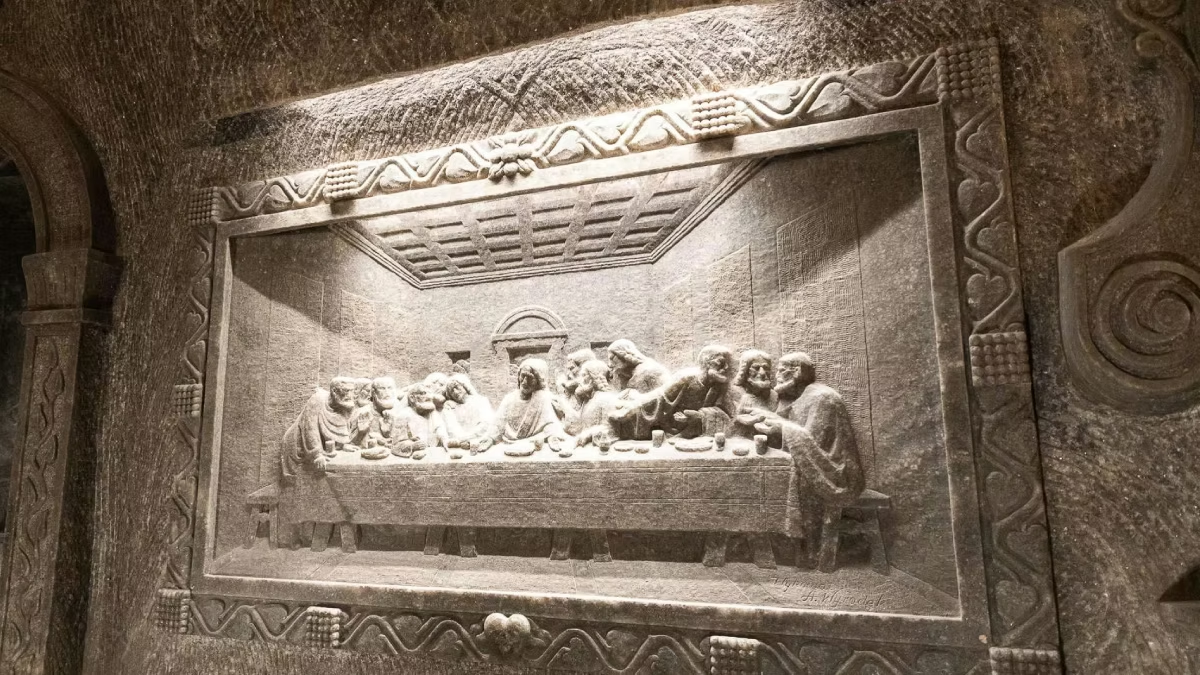
Salt is the reason Kraków exists as a city of consequence. For most of the medieval period, salt was the oil of its age — essential for preserving food, conducting trade, and financing kingdoms. The mine at Wieliczka, just 14 km from the city, made Poland wealthy for centuries. It funded universities, paid for armies, and financed the construction of one of Central Europe’s great cities. Seven hundred years of that history lies underground, carved into the walls.
Origins — Before the Mine
Wieliczka Salt Mine has been in continuous operation since the 13th century, making it one of the oldest operating salt mines in the world. Commercial rock salt mining ceased in 1996 due to falling prices and flooding. The mine was placed on the original UNESCO World Heritage List in 1978 — one of the first 12 sites ever inscribed. Today it functions as a heritage site, health resort, and tourist attraction welcoming over 1.5 million visitors per year.
Salt had been extracted from the Wieliczka area since Neolithic times, long before the mine existed. Brine springs — groundwater saturated with dissolved salt — surfaced naturally and were collected and evaporated in clay vessels to produce table salt. The oldest salt-working tools in Central Europe, found near Wieliczka, date to approximately 3,500 years before the common era.
The geological basis for this abundance is a rock salt deposit formed approximately 13.6 million years ago during the Miocene period, when a shallow sea covered the region. As the sea evaporated and the Carpathian Mountains rose to the south, thick layers of salt were compressed and sealed underground. The result was one of the richest rock salt deposits in Europe.
The 13th Century — First Shafts
As the natural brine springs weakened during the early medieval period, miners began sinking wells and, eventually, shafts into the rock salt below. The first documentary evidence of organised rock salt mining at Wieliczka dates to the 13th century. The Wieliczka mine received its formal charter from King Casimir III in 1368 — establishing the legal framework, workers’ rights, and the tax structure that would govern the mine for centuries.
The mine was operated throughout its history by the Żupy Krakowskie — the Kraków Salt Mines company — under royal control. It was a royal asset, and its revenues flowed directly to the Polish crown.
The 14th–15th Centuries — “White Gold”
Under King Casimir III of Poland (1333–1370), known as Casimir the Great, the mine reached a new level of economic significance. Salt revenues from Wieliczka accounted for as much as a third of the total royal treasury income during his reign. This wealth funded the founding of the Jagiellonian University in Kraków (1364) — Poland’s first university — as well as extensive building programmes that transformed the city. The popular saying holds that Casimir “found Poland built of wood and left it built of stone.” Much of the stone came from the revenues of Wieliczka salt.
By the end of the 15th century, approximately 350 people worked in the mine, producing 7,000–8,000 tonnes of salt annually. Nicolaus Copernicus, who would later transform humanity’s understanding of the solar system, is believed to have visited the mine around 1493 — making him one of the first known tourists in the mine’s history. A monumental salt statue of him stands today in the chamber that bears his name.
The 16th–17th Centuries — The Golden Age
The 16th and 17th centuries were the peak of Wieliczka’s productive life. The mining workforce grew to approximately 2,000 people, annual salt production reached 30,000 tonnes, and the mine expanded to three levels. The first underground chapels were carved during this period — miners creating devotional spaces in the environment where they worked, lived, and sometimes died. The Chapel of St. Anthony, the oldest surviving chapel in the mine, dates to the 17th century.
Tourism to the mine began during this period. Guest books were introduced in 1774 and have been maintained continuously since — they are among the most remarkable visitor records in European heritage history. Goethe visited in 1790 and was reportedly deeply moved by the underground experience.
Tourism at Wieliczka dates from the early 18th century. Guest books were introduced in 1774. Notable early visitors included Nicolaus Copernicus (c.1493), Johann Wolfgang von Goethe (1790), and Alexander von Humboldt. The mine has been a formal tourist attraction since the 19th century.
The Habsburg Period (1772–1918)
In 1772, Poland was partitioned and Wieliczka came under Habsburg rule. The mine became one of the most important industrial enterprises in the entire Austrian Empire — at the height of Habsburg ownership, it was considered one of the most productive mines in the world. Austrian management introduced systematic engineering improvements, including mechanised lifting equipment and improved ventilation. Tourism became an increasingly important secondary income source, and the mine’s reputation spread across Europe.
Scientific interest in the mine’s therapeutic microclimate developed during this period. In the 19th century, physicians began treating patients with respiratory conditions in the underground chambers, establishing what would eventually become the Wieliczka Salt Mine Health Resort.
The 20th Century — Mechanisation and World War II
The early 20th century brought electrification, mechanical drills, and explosive charges to Wieliczka. Annual salt production reached its historic peak during this period.
World War II brought a darker chapter. During the Nazi occupation of Poland, the Germans established an underground armament factory in the mine’s largest chamber, the Staszic Chamber. Between 1944, several thousand Jewish concentration camp prisoners were transported from forced labour camps at Płaszów and Mielec to the mine, intended to provide labour for the factory. The Soviet offensive approaching from the east caused the project to be abandoned before production began. The prisoners were transported to factories in Litoměřice and Linz. The mine itself survived the war largely intact — the Germans had identified its heritage value and took measures to preserve its historic features.
1978 — UNESCO World Heritage
In 1978, Wieliczka Salt Mine was inscribed on the UNESCO World Heritage List — one of the original 12 sites on the inaugural list. The inscription recognised the mine as an outstanding example of industrial heritage, artistic expression, and the integration of human creative work with natural geological processes.
The mine was subsequently placed on the List of World Heritage in Danger from 1989 to 1998, due to humidity damage caused by artificial ventilation introduced in the 19th century. The damage to sculptures was assessed and addressed through a major conservation programme, and the mine was removed from the danger list in 1998.
In 2010, the nearby Bochnia Salt Mine was added to the UNESCO listing, creating the joint inscription “Wieliczka and Bochnia Royal Salt Mines.” In 2013, the Wieliczka Saltworks Castle was added to the serial property.
1996 — End of Commercial Mining
Commercial rock salt mining at Wieliczka ended in 1996, due to a combination of falling salt prices on global markets and slow but inexorable flooding of the lower levels. The mine had been in continuous production since the 13th century — over 700 years of uninterrupted operation. The total amount of rock salt extracted over that period is estimated at 23 million tonnes.
Mining did not stop entirely. Today, several hundred miners continue to work underground — not extracting salt, but maintaining the physical integrity of the mine, managing water ingress, reinforcing galleries, and restoring historic chambers. The mine’s continued existence as a heritage site depends on this ongoing maintenance work.
Frequently Asked Questions
How old is Wieliczka Salt Mine?
Rock salt mining at Wieliczka has been documented from the 13th century. Salt was extracted from brine springs at the site since Neolithic times. The mine operated continuously for over 700 years until commercial production ended in 1996.
Why did Wieliczka Salt Mine stop producing salt?
Commercial rock salt mining ended in 1996 due to falling global salt prices and progressive flooding of the lower mine levels. The mine still produces salt in a small way — underground brine is collected and evaporated to produce a premium table salt product.
When was Wieliczka Salt Mine added to UNESCO?
In 1978 — it was one of the original 12 sites on the inaugural UNESCO World Heritage List. The listing was expanded in 2010 to include Bochnia Salt Mine, and in 2013 to include Wieliczka Saltworks Castle.
Did anything happen at Wieliczka Salt Mine during World War II?
Yes. The Germans established an underground armament factory in the Staszic Chamber. Jewish concentration camp prisoners were transported to the mine in 1944 to provide forced labour. The project was abandoned as the Soviet offensive approached, and the prisoners were moved to other facilities.
Who were the most famous visitors to Wieliczka Salt Mine?
Notable historic visitors include Nicolaus Copernicus (c.1493), Goethe (1790), Alexander von Humboldt, Frédéric Chopin, Dmitri Mendeleev, Pope John Paul II (three times during his life), and President Bill Clinton.
