
Salt Sculptures & Artwork
One of the most enduring questions about Wieliczka is also one of the most revealing: why did miners spend their limited rest time carving an underground cathedral? The answer tells you something important about the nature of labour, faith, and creative impulse in confined spaces. For over 700 years, the people who worked in this mine also shaped it into something that had nothing to do with extracting salt — and the result is unlike anything else on earth.
The Tradition of Miner-Artists
Wieliczka Salt Mine contains dozens of salt sculptures and bas-relief carvings created by miners over 700 years, from the 14th century to the present. The subjects range from religious figures and biblical scenes to historical figures, Polish legends, and allegorical compositions. All are carved from the mine’s natural grey rock salt. The most celebrated works are in St. Kinga’s Chapel, but significant sculptures appear throughout all 22 chambers of the Tourist Route.
The carving of sculptures in the mine began as a religious practice — miners creating devotional objects and chapels in the dangerous environment where they worked. Over time, religious carving expanded into historical commemoration, folklore illustration, and eventually pure artistic expression.
The sculptors were primarily miners — men who worked with salt extraction tools and applied the same skills to artistic creation. Some became extraordinarily skilled. The brothers Józef and Tomasz Markowski and Antoni Wyrodek, the primary artists of St. Kinga’s Chapel, spent decades underground developing techniques for working with rock salt that produced results comparable to professional stonework. Their tools were the same tools they used for mining.
This tradition continues today. The mine’s maintenance workers and a small number of contemporary artists are still adding to and restoring the sculptural heritage of the mine. New carvings appear alongside work from the 18th and 19th centuries. When you walk the Tourist Route, you are walking through seven centuries of artistic accumulation.
The Material
Rock salt at Wieliczka is not white — it is grey, in various shades of green-grey, brown-grey, and silver-grey depending on the mineral composition at any particular location in the deposit. It resembles unpolished granite in photographs and in person. The salt is relatively soft compared to stone, which makes initial carving easier, but it is brittle at thin edges and requires specific techniques to prevent cracking.
The natural colour variation in the salt provides an additional creative resource. Green salt, brown salt, and grey-silver salt produce different visual qualities in finished sculptures. Some pieces are deliberately carved to take advantage of colour boundaries within the same block of salt.
The chandeliers in St. Kinga’s Chapel are made from a different process — salt crystals dissolved in water and reconstituted to grow clear, glass-like formations that refract light. This technique produces the transparent quality that makes the chandeliers appear luminous rather than grey.
Key Works on the Tourist Route
The Copernicus Statue (Copernicus Chamber, Level 1): A monumental seated figure of Nicolaus Copernicus, carved in green salt and installed in 1973 on the 500th anniversary of his birth. The astronomer is believed to have visited the mine around 1493. The chamber takes its name from this work.
The Kinga Legend Group (Janowice Chamber, Level 1): A sculptural group depicting the founding legend of the mine — a miner handing Princess Kinga the first lump of Wieliczka salt, with her engagement ring visible within it. The group includes figures of Polish and Hungarian knights. It tells the origin story of the mine in three dimensions.
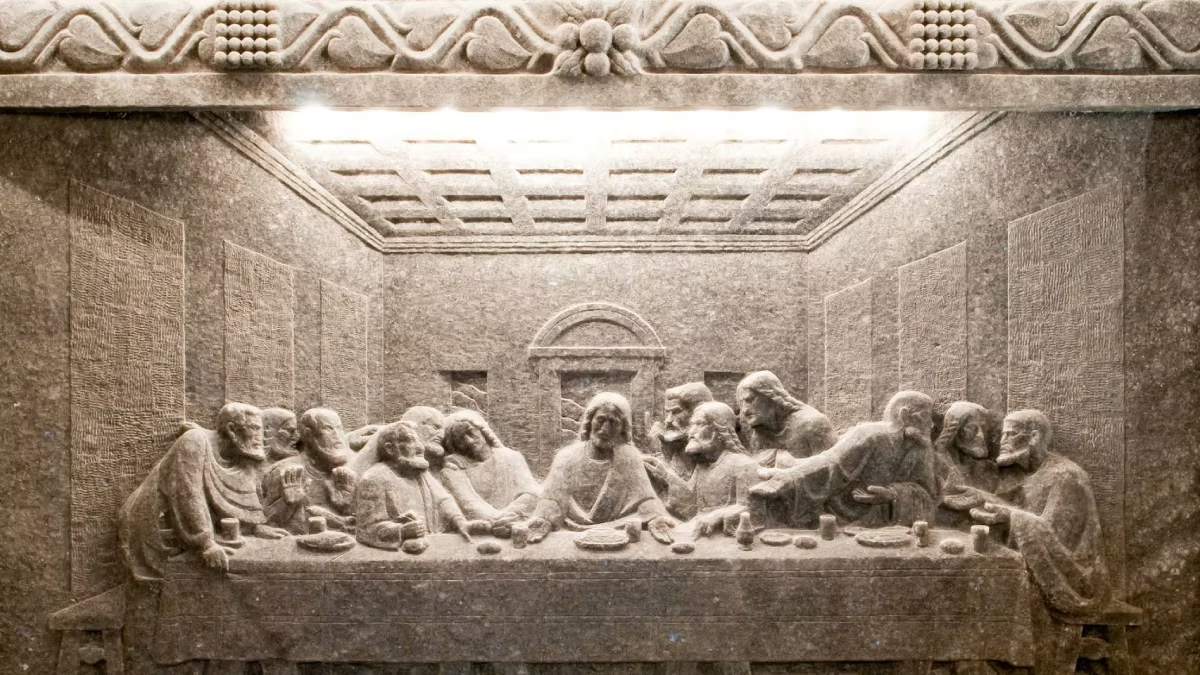
The Last Supper Relief (St. Kinga’s Chapel, Level 3): Carved by Antoni Wyrodek, this bas-relief takes Leonardo da Vinci’s painting as its source and translates it into rock salt with extraordinary technical precision. The figures are clearly individualised and the composition is faithful to the original. It is the most technically sophisticated single work in the mine.
The Nativity and Biblical Panels (St. Kinga’s Chapel, Level 3): The chapel walls are lined with bas-relief panels depicting scenes from the New Testament. Carved with mining tools over decades, these scenes combine religious subject matter with the particular aesthetic of salt carving — slightly stylised, heavy in outline, powerful in total effect.
The Main Altar (St. Kinga’s Chapel, Level 3): Carved by Tomasz Markowski, the three-part altar features statues of St. John, St. Clement, and St. Kinga. A relic of St. Kinga is contained in a niche beneath the altar top. The altar was carved from a single mass of rock salt and is the focal point of the entire chapel.
The Statue of John Paul II (St. Kinga’s Chapel, Level 3): Installed in 1999 following Kinga’s canonisation by Pope John Paul II, this is the only statue of the saint in the world made from salt. Sculpted by Stanisław Anioł and his assistants, it stands in the chapel alongside a salt crystal sculpture of Our Lady of Lourdes.
The Pulpit (St. Kinga’s Chapel, Level 3): The lower section of the pulpit, carved by Tomasz Markowski, represents Wawel Hill and Kraków’s Royal Castle — connecting the mine’s religious heritage directly to the city whose treasury it helped fill for centuries.
The Treasurer Spirit Statue (Level 3): A figure of the Skarbnik — the mythical underground guardian spirit of the mine — appears near the end of the Tourist Route. Polish mining folklore maintains that the Treasurer is a caring figure who warns miners of danger. The statue is carved in characteristic grey salt and has become one of the most affectionately regarded figures in the mine.
The mine contains dozens of significant sculptures and bas-relief works, plus hundreds of smaller carved figures and decorative elements. The Tourist Route alone passes through chambers with major sculptural works from multiple centuries, from the 17th-century Chapel of St. Anthony to the late 20th-century additions to St. Kinga’s Chapel.
Contemporary Additions
The sculptural tradition is not static. Miners today continue to add to and restore works throughout the mine. Contemporary artists are also invited to create new works, particularly in sections not on the standard Tourist Route. The boundary between historical and contemporary is deliberately blurred in some chambers — the newest carvings take the same approach to material and subject matter as their 18th-century predecessors.
Photography of the Sculptures
Photography of all sculptures is permitted throughout the mine. Flash is prohibited near the sculptures — both to protect the salt from micro-vibrations caused by repeated flash bursts and to preserve surface quality over time. The mine’s installed lighting is designed to showcase each sculpture in context; photographs taken without flash produce better results in any case, as the natural lighting produces more even and atmospheric results than flash.
Frequently Asked Questions
Who carved the sculptures at Wieliczka Salt Mine?
The sculptures were created primarily by miners who developed carving skills alongside their mining work. The most celebrated artists — brothers Józef and Tomasz Markowski and Antoni Wyrodek — were the primary creators of St. Kinga’s Chapel. Contemporary artists and mine workers continue the tradition of adding new works today.
Are all the sculptures at Wieliczka Salt Mine old?
No — the sculptural tradition spans from the 17th century to the present. New carvings are still being created, and older works are continuously restored. The Tourist Route contains works from across this entire range.
What is the most famous sculpture in Wieliczka Salt Mine?
St. Kinga’s Chapel as a complete work is the most celebrated. Within it, the Last Supper bas-relief by Antoni Wyrodek is widely considered the finest single piece of carving in the mine.
Are the sculptures white?
No. Rock salt is naturally grey — varying shades of grey-green, grey-brown, and silver-grey. Sculptures carved from it look similar to unpolished stone. The chandeliers are made from reconstituted salt crystals and appear transparent and luminous.
Can I touch the salt sculptures?
Touching the sculptures is not permitted and visitors are asked not to lick the walls. The prohibition protects both the sculptures from surface degradation caused by oils and moisture from skin, and visitors from consuming industrial-grade rock salt that has been exposed to centuries of underground conditions.
